Direct answer
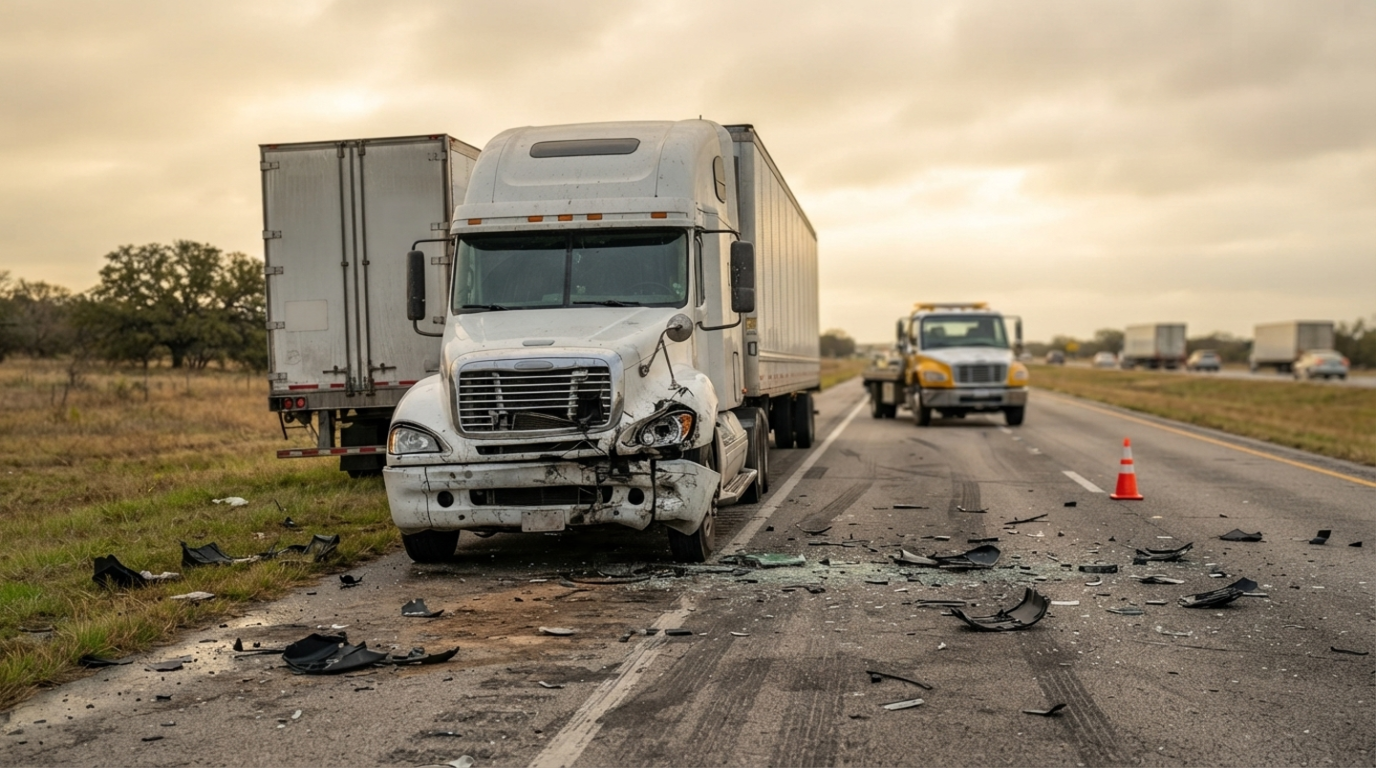
Texas 18-wheeler and truck accident lawyers investigate who caused a commercial-vehicle collision, preserve truck and electronic evidence, identify available coverage, and prove the injured person’s losses. A strong claim connects Texas liability law with applicable federal safety rules and reliable medical evidence. At the Law Firm of Aaron A. Herbert, that preparation supports informed settlement decisions and readiness for trial when a reasonable resolution cannot be reached.
Rule or legal standard
What must you prove after a Texas truck accident
A negligence claim generally requires proof of a duty, a breach of that duty, proximate cause, and damages. The truck’s size or the seriousness of an injury does not automatically establish negligence. Counsel must identify what the driver or another responsible party did, why it fell below the applicable standard, and how it caused the collision and resulting injury.
A driver may be responsible for an unsafe lane change, distraction, improper speed, or another supported act. A carrier may face vicarious responsibility for its employee’s conduct within the scope of employment. Direct claims against a business require their own legal and factual foundation. A maintenance contractor, equipment manufacturer, loader, or other entity should be evaluated only when evidence supports a legally recognized claim against it.
Texas Civil Practice and Remedies Code Chapter 72 contains special provisions for covered commercial motor vehicle collision actions. Sections 72.052 through 72.054 address bifurcation, regulatory evidence, and the effect of an employer’s qualifying stipulation concerning employment and scope. Exceptions and the particular claims matter. A timely motion can require separate compensatory and exemplary-damages phases. These provisions make early pleading and trial planning important; they do not eliminate every claim involving a trucking business. [1]
Which federal trucking rules matter
Counsel should determine the operation, vehicle, carrier, and rule applicability before alleging a federal violation. Interstate operations, intrastate operations, vehicle classifications, and exceptions can require different analyses. A citation to the entire Federal Motor Carrier Safety Regulations is less useful than identifying the particular provision governing the disputed conduct.
For covered property-carrying drivers, the standard hours-of-service framework includes an 11-hour driving limit after 10 consecutive hours off duty, a 14-hour driving window, applicable break requirements, and weekly on-duty limits. Exceptions can change the analysis. See 49 C.F.R. §§ 395.1, 395.3 and FMCSA’s summary. [2] A log violation is an investigative lead; causation still requires evidence connecting the violation to the crash.
Weather can create a separate issue. Under 49 C.F.R. § 392.14, hazardous conditions affecting visibility or traction require extreme caution and reduced speed; sufficiently dangerous conditions can require discontinuing operation. [3] Compliance with a posted speed limit does not resolve whether the driving was appropriate for actual conditions.
How does Texas comparative fault affect recovery
For claims governed by Chapter 33, responsibility exceeding 50 percent bars a claimant’s recovery. An allowable recovery is reduced by the claimant’s responsibility, with other adjustments potentially applicable. Tex. Civ. Prac. & Rem. Code §§ 33.001, 33.012. [4] An insurer’s initial percentage is not a final legal determination. Video, vehicle movements, witness testimony, and reconstruction evidence may challenge it.
How long do you have to bring a claim
Texas Civil Practice and Remedies Code § 16.003 generally supplies a two-year limitations period for personal injury claims. Accrual, disability provisions, notice requirements, and other exceptions need individual review. [5] Settlement negotiations do not ordinarily pause the clock. Timely filing must also be accompanied by diligence in pursuing service when necessary. See Proulx v. Wells, 235 S.W.3d 213, 215–16 (Tex. 2007). [6]
Why it matters
A commercial-truck case can involve a driver, several businesses, different equipment owners, and multiple electronic systems. A tractor’s data may answer one question while a trailer inspection answers another. The carrier’s dispatch records may supply context that the crash report never captured. The work is to connect these sources into a reliable explanation of responsibility.
For an injured person, the legal detail has a practical purpose. Preserving an original video can prevent a dispute from turning entirely on conflicting recollections. Obtaining the correct corporate records can identify who controlled an unsafe operation. Medical and vocational evidence can show why a lasting injury affects future work rather than merely document days already missed.
For practitioners and referring attorneys, early decisions can determine what remains available months later. Define the collision theory, locate evidence custodians, identify the applicable commercial-vehicle provisions, and coordinate experts before making assumptions about what the equipment recorded. A large document production is valuable only when it resolves a material question and can be used in a legally appropriate way.
Consider a hypothetical collision on LBJ Freeway near US 75 in Dallas. A photograph showing two damaged vehicles does not establish which vehicle entered the lane first. A dash camera, witness, scene measurement, or sufficiently reliable vehicle dataset might help. A collision near the Dallas Mixmaster or along I-20 raises the same need to identify the exact location, direction, roadway configuration, and sequence. These are investigation examples, not claims that a particular intersection has a verified crash ranking.
Evidence required
Preserve the tractor and trailer as separate evidence sources
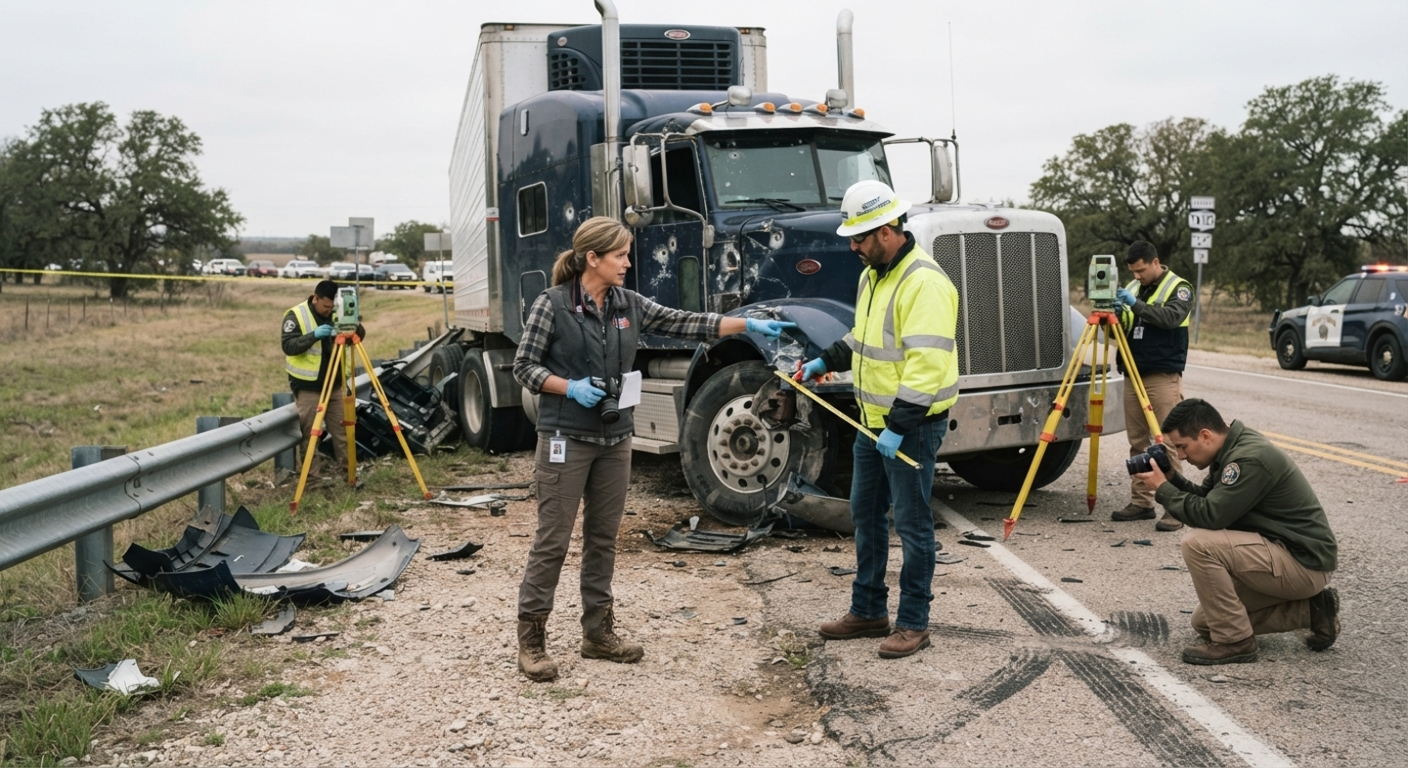
Identify the tractor and trailer by vehicle identification numbers, unit numbers, ownership, and present location. Determine whether either is scheduled for repair, salvage, sale, or return to service. Counsel can seek a preservation agreement, lawful inspection, or appropriate court relief. Retaining counsel does not itself transfer ownership or create an automatic right to take possession of someone else’s equipment.
Tractor inspection and data capture
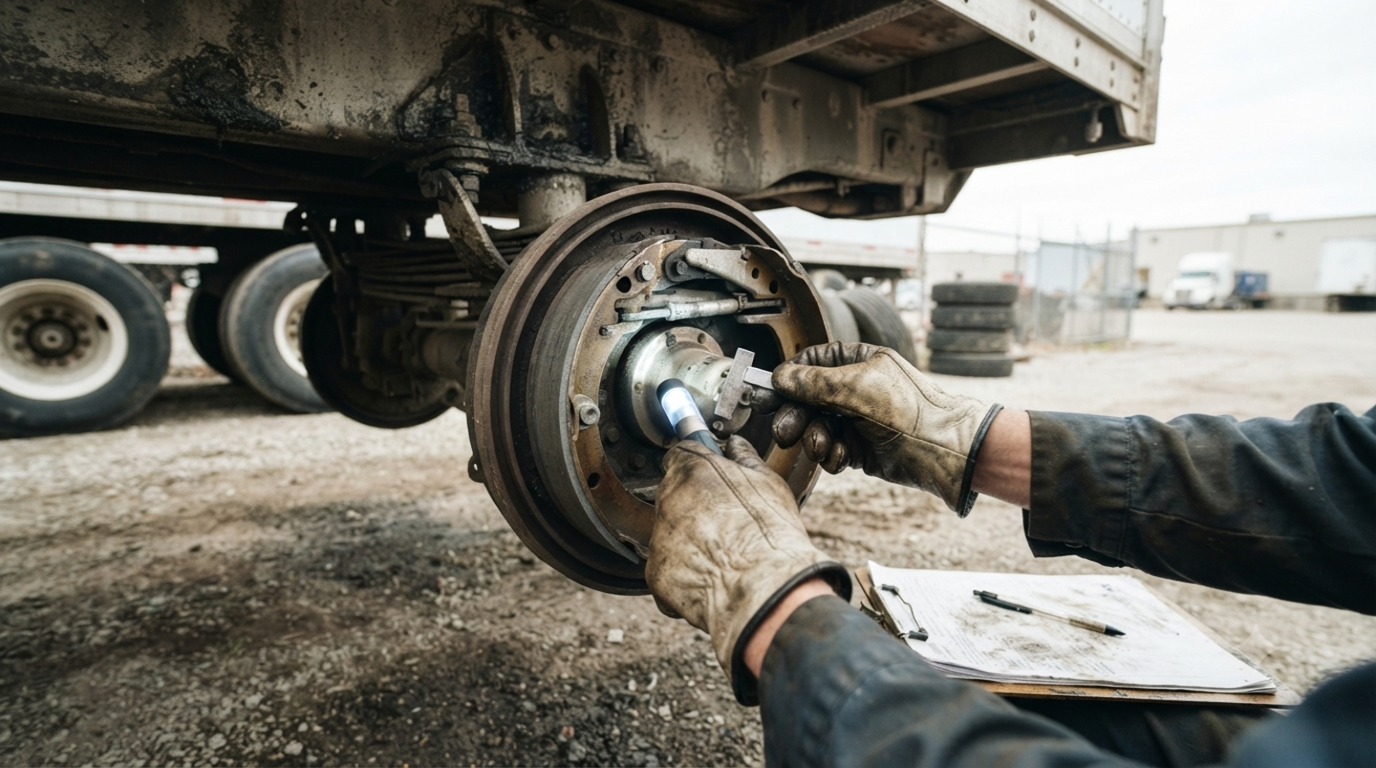
An inspection should follow a documented protocol. Depending on the issue, a qualified expert may examine brakes, tires, lighting, coupling components, steering, damage patterns, or trailer structure. Preserve relevant parts and record their condition before authorized testing. Do not assume every defect existed before impact; collision damage can alter the equipment being examined.
Trailer condition and component evidence
Trailer evidence can be critical in an underride, jackknife, cargo-shift, or conspicuity dispute. Tractor evidence can help evaluate braking, vehicle operation, or a reported mechanical problem. An engineer should explain which observations support a conclusion and which questions remain unresolved. Photographing equipment is useful, but photographs alone may not answer a technical causation question.
Distinguish ELD records from crash and telematics data
Required ELD information
Electronic logging devices primarily document duty status and required associated information. Section 395.26 lists automatically recorded elements such as time, location, engine hours, vehicle miles, and identifiers. It does not establish a universal second-by-second speed or braking record. [7] An integrated platform may separately collect telematics; the investigator must identify that additional system and its actual capabilities.
Vehicle event data and separate telematics
Engine-control-module or other vehicle data may help evaluate speed, braking, or an event when the installed system captured and retained relevant information. Availability, sampling, triggering, accuracy, and overwrite behavior differ. Obtain a qualified interpretation and preserve native data where feasible. A screenshot labeled “black box” does not by itself establish what the truck did at impact.
Clock synchronization and data limits
Compare time bases before combining datasets. A camera, dispatch platform, and vehicle system may use different clocks or recording intervals. Counsel and experts should document synchronization assumptions rather than force conflicting timestamps into a preferred story. A defensible timeline acknowledges uncertainty where the underlying information cannot resolve it.
Obtain driver and operational records
Relevant material can include duty-status records, dispatch communications, trip documents, driver qualification information, maintenance records, training records, and vehicle-inspection reports. The particular request should follow the theory of the case. A fatigue allegation calls for different supporting material than a disputed trailer brake failure.
Under 49 C.F.R. § 395.8(k)(1), covered duty-status records and supporting documents must be retained for at least six months from receipt. [8] That is a regulatory minimum, not a guarantee of deletion on the next day or a universal deadline for preserving a lawsuit’s evidence. Other evidence can have different retention periods. Litigation preservation duties require separate analysis.
Driver vehicle inspection reports also have qualifications. Section 396.11 contains reporting, repair, retention, and exception provisions, including circumstances in which a no-defect report is not required. [9] Do not treat the absence of a daily report as conclusive proof of a violation without checking the rule that applied to that operation.
Locate outside evidence and evaluate reconstruction
Investigators may identify independent witnesses, nearby businesses with potentially relevant footage, tow records, photographs, and emergency-response information. Request records lawfully and act promptly where overwrite risk exists. A business near the scene might have a camera; its presence, field of view, functionality, and retention still need verification.
A reconstructionist may analyze physical evidence, vehicle movements, road geometry, and reliable electronic information. A lawful drone survey or other measured scene capture may assist with geometry or presentation. Present-day imagery must be checked against construction and other changes since the collision. It cannot independently establish historical traffic movements or what a driver actually saw.
A useful accident visualization should explain supported facts and clearly identify assumptions. Animation can help jurors understand a complex sequence, but visual confidence must not exceed evidentiary confidence. Separate demonstrative illustrations from scientifically supported reconstructions, and prepare the foundations appropriate to the intended use.
Prove medical causation and the full damages picture
Medical causation and prior conditions
Obtain treatment records, imaging, operative reports, prognosis information, and the history relevant to causation. Earlier symptoms or another collision should be disclosed and evaluated rather than ignored. JLG Trucking, LLC v. Garza, 466 S.W.3d 157, 162–65 (Tex. 2015), illustrates the importance of competing causal explanations. Complex medical questions often require expert evidence. [10]
Recoverable medical expenses and separate losses
Potential damages can include past and future medical expenses, income loss, diminished earning capacity, pain, mental anguish, physical impairment, and disfigurement where legally and factually supported. Each category needs its own foundation. An impressive total bill does not automatically prove recoverable medical expenses. Section 41.0105 and Haygood v. De Escabedo, 356 S.W.3d 390, 396–400 (Tex. 2011), address amounts actually paid or incurred. [11]
Future care and earning capacity
For catastrophic injuries, treating specialists, life-care planners, vocational professionals, and economists may address different questions. Medical recommendations should support anticipated care; vocational evidence should address work capacity; financial analysis should identify its assumptions. These disciplines should fit together without duplicating losses or turning uncertain needs into guaranteed expenses.
Exceptions and limitations
Insurance minimums are not settlement promises
Section 387.9 specifies financial-responsibility minimums by covered operation and commodity. It includes $750,000 for specified nonhazardous interstate for-hire property carriage and higher amounts for certain hazardous-material operations. [12] These are not a promised settlement range for every Texas truck collision.
Actual recovery depends on liability, damages, applicable coverage, exclusions, limits, other claimants, assets, and collection issues. Identify potentially available primary and excess policies without assuming that policies automatically stack or that every defendant carries separate collectible coverage. A policy limit and a supportable claim value are different questions.
A regulatory violation does not decide the whole case
The applicable rule, its legal effect, causation, and admissibility must be analyzed. A driver could exceed a duty limit without that violation causing the particular collision. Conversely, a driver within the standard hours limits might still drive negligently. Build the causal explanation rather than treating a regulatory citation as an automatic verdict.
A carrier’s historical inspection information can identify leads, but prior events may involve different equipment, drivers, conduct, or circumstances. Investigate relevance and evidentiary limitations before portraying a public record as proof of this crash. The claim should focus on supported conduct tied to the loss.
Evidence loss does not guarantee sanctions
Brookshire Brothers, Ltd. v. Aldridge, 438 S.W.3d 9, 20–26 (Tex. 2014), addresses preservation duties and spoliation remedies in Texas. The circumstances of the loss and the governing standards matter. [13] A preservation letter is important, but it does not create evidence, compel immediate production, or guarantee an adverse jury instruction.
In federal litigation, Federal Rule of Civil Procedure 37(e) addresses qualifying lost electronically stored information. [14] The forum and type of evidence affect the analysis. Counsel should seek available evidence and appropriate relief while avoiding assumptions that destruction automatically establishes negligence or case value.
Fatalities and special parties require separate analysis
Wrongful-death and survival claims involve distinct rights, beneficiaries, and recoverable losses. Texas Civil Practice and Remedies Code Chapter 71 is a starting point. [15] A relative’s grief does not alone resolve statutory standing. Identify proper claimants and any estate-related requirements before negotiating a comprehensive resolution.
Government involvement, a claimant’s minority or incapacity, employment status, and benefit eligibility can introduce additional rules. These issues can affect deadlines, remedies, approval procedures, and distribution. A general truck-accident guide should prompt early evaluation rather than suggest one strategy fits every collision.
Aaron’s analysis
When I evaluate a truck accident claim, I want the investigation to answer the questions that matter to the client’s recovery. Who controlled the driver’s work? What did the equipment and recordings actually preserve? Which facts support negligence? What connects the collision to the medical condition? What losses remain after the immediate treatment ends?
For the injured person, trial preparation matters long before a jury is selected. A well-prepared case gives the client a clearer understanding of an offer and its limits. If responsibility or damages remain disputed, counsel should explain the missing proof, the available ways to obtain it, the cost, and the litigation risk. The settlement decision should be informed rather than driven by a slogan or an unsupported average.
I am board certified in Personal Injury Trial Law by the Texas Board of Legal Specialization, as reflected in my State Bar profile. [16] When choosing counsel, ask how that lawyer handles commercial-vehicle evidence, medical causation, corporate discovery, expert work, and trial decisions. Certification is a meaningful credential to consider alongside the lawyer’s explanation of the case, communication, and proposed investigation.
For practitioners, a disciplined trial plan should connect each witness and exhibit to a necessary proposition. A corporate representative may explain a relevant operational process. A reconstruction expert may address the collision sequence. A medical expert may establish causation and prognosis. No witness should be asked to supply an opinion outside the witness’s actual expertise.
Our objective is to develop reliable proof, communicate the uncertainty, and advocate for a recovery supported by the evidence and law. A serious injury deserves careful attention to future needs and the client’s net position. No credential, case result, or investigation method guarantees a particular outcome.
Practical steps
Protect health and preserve what you already have
Call emergency services when needed and obtain appropriate medical evaluation. Give an accurate account of the incident and symptoms. Follow medical advice, and explain barriers to treatment to the provider and counsel. The claim should document genuine care needs rather than direct care for litigation purposes.
If safe, preserve photographs, witness contacts, the truck’s identifying markings, and the precise location. Keep original recordings, messages, and insurance correspondence. Do not approach dangerous traffic or damaged equipment to obtain evidence. Do not delete relevant material, including information that may be unfavorable.
Obtain the report and identify the right records
TxDOT provides guidance for qualifying requesters to obtain Texas crash reports. [17] A report can help identify parties, vehicles, witnesses, and the responding agency. It does not conclusively determine civil fault. Tell counsel about inaccuracies and preserve supporting material rather than assume the report cannot be questioned.
For a Dallas-area collision, specify whether the location was in Dallas city, elsewhere in Dallas County, or another county. Identify a mile marker, frontage road, direction, or interchange where possible. Geographic precision helps locate witnesses and records. It also prevents broad Dallas references from obscuring the actual scene.
Review the agreement and the investigation plan
Ask who will handle the case, how updates occur, what expenses may be incurred, and how fees and costs are calculated. Read the written representation agreement. Request an explanation of the investigation priorities, immediate preservation work, and the applicable deadlines.
You do not need every record before seeking advice. Bring what you have and identify where other information may exist. Discuss previous injuries, other claims, employment changes, and insurer communications openly. Early candor helps counsel address issues before they become surprises in a deposition or medical review.
Use targeted discovery and corporate depositions
After filing, discovery can seek relevant documents, electronically stored information, and testimony under the applicable rules. Texas Rule of Civil Procedure 199.2(b)(1) addresses designated organizational testimony; Federal Rule 30(b)(6) applies in federal litigation. [14, 18] Topics should be sufficiently focused and connected to issues such as dispatch decisions, maintenance practices, or data retention.
For practitioners, sequence discovery so the documents needed to question a witness are available first when feasible. Identify the correct corporate custodian and the systems involved. Address privilege and scope disputes through appropriate procedures. For clients, this work can clarify who knew what and which practices affected the trip rather than rely solely on the individual driver’s memory.
Prepare the damages case before mediation
A mediation evaluation should include the supported liability theory, defense arguments, treatment course, prognosis, future losses, and collection issues. Explain the proposed gross recovery and expected deductions. An unresolved reimbursement obligation can materially affect what the client receives.
Medicare may seek repayment of related conditional payments following a settlement or other recovery. CMS explains its reporting and recovery process. [19] Other reimbursement claims require their own analysis. Counsel should distinguish verified obligations from estimates and review disputed charges through the relevant process.
Prepare for trial while keeping settlement available
Voir dire can address potential bias about truck accidents, corporate responsibility, medical evidence, and damages within the court’s limits. Jury consultants may assist when the case warrants the expense. Their use should follow a specific need rather than become a claim that every case receives the same resources.
Prepare witness foundations, expert admissibility, demonstrative exhibits, and the legal questions the factfinder must answer. Review any applicable Chapter 72 procedure and preserve necessary objections. A visually persuasive case still requires legally admissible proof. Settlement discussions can continue while this preparation proceeds.
Evaluate an offer through the client’s actual needs
Before signing a release, understand the parties and claims being released, payment conditions, deductions, and any future-care planning. A settlement may end the ability to pursue later consequences of the same incident. Ask how the proposal addresses permanent restrictions and earning capacity, not just current bills.
Compare the offer with realistic litigation possibilities, expenses, delay, and collection risk. The client chooses whether to settle after receiving informed advice. A confident recommendation should explain its assumptions and limitations rather than promise that a jury will award a particular amount.

FAQ
Can I sue a trucking company as well as the driver
Potentially. Employment, scope of work, operational conduct, applicable law, and Chapter 72 provisions can affect the available claims. Identify the correct legal entity and evidence supporting its responsibility. A logo on a trailer is an investigative lead, not a complete liability analysis.
What is the average Texas 18-wheeler accident settlement
There is no reliable universal average that predicts your recovery. Severity, causation, fault, future losses, coverage, expenses, and reimbursement issues differ. Ask for a case-specific explanation of supported damages and risk rather than a number derived from unrelated advertised results.
Does an ELD prove the truck’s speed at impact
Not necessarily. Mandatory ELD information is not equivalent to a complete crash recorder. [7] Separate telematics, vehicle-system data, or video may help when available and reliably interpreted. Counsel should identify the actual installed systems before promising what a download will show.
Is six months the deadline to preserve truck evidence
No. Section 395.8 specifies a minimum retention period for covered records; other materials and litigation duties differ. [8, 13] Important footage or physical evidence may be at risk much sooner. Seek advice promptly rather than treat six months as a safe waiting period.
What if the truck driver blames me
Preserve the evidence and tell counsel exactly what happened, including facts that concern you. For claims governed by Chapter 33, the claimant’s responsibility can reduce or bar recovery. [4] The driver’s assertion does not conclusively determine the allocation.
Can I obtain compensation for lifelong care
A supportable claim may include future medical needs and other lasting losses. Qualified medical and financial evidence should establish the connection to the injury, anticipated needs, and reasonable assumptions. A life-care plan is strongest when its recommendations have a defensible medical foundation.
Should I give a recorded statement to the carrier’s insurer
Seek case-specific advice before providing a recorded statement to an opposing insurer. Communications can affect the claim. Obligations under your own policy may differ, so do not assume that all insurers and requests should be handled the same way.
How do I choose a Texas truck accident lawyer
Ask about commercial-vehicle investigation, electronic and physical evidence, expert selection, communication, fees, expenses, and litigation planning. Verify claimed credentials through the appropriate source. A lawyer should explain how those capabilities serve your particular case without guaranteeing a result.
Primary authorities
Source review date October 7, 2026. These authorities support the discussion; their application depends on the collision, parties, forum, and governing rules.
- [1] Texas Civil Practice and Remedies Code §§ 72.051–72.055.
- [2] 49 C.F.R. §§ 395.1, 395.3; FMCSA Summary of Hours of Service Regulations.
- [3] 49 C.F.R. § 392.14.
- [4] Texas Civil Practice and Remedies Code §§ 33.001, 33.012.
- [5] Texas Civil Practice and Remedies Code §§ 16.001, 16.003.
- [6] Proulx v. Wells, 235 S.W.3d 213 (Tex. 2007). Supreme Court opinion.
- [7] 49 C.F.R. § 395.26.
- [8] 49 C.F.R. § 395.8(k)(1).
- [9] 49 C.F.R. § 396.11.
- [10] JLG Trucking, LLC v. Garza, 466 S.W.3d 157 (Tex. 2015). Supreme Court opinion.
- [11] Texas Civil Practice and Remedies Code § 41.0105; Haygood v. De Escabedo, 356 S.W.3d 390 (Tex. 2011). Supreme Court opinion.
- [12] 49 C.F.R. § 387.9.
- [13] Brookshire Brothers, Ltd. v. Aldridge, 438 S.W.3d 9 (Tex. 2014). Supreme Court opinion.
- [14] Federal Rules of Civil Procedure, including Rules 30(b)(6) and 37(e).
- [15] Texas Civil Practice and Remedies Code Chapter 71.
- [16] State Bar of Texas, Aaron Alan Herbert profile and Personal Injury Trial Law certification listing.
- [17] TxDOT Crash Reports and Records.
- [18] Texas Rules of Civil Procedure, particularly Rule 199.2(b)(1).
- [19] CMS Medicare’s Recovery Process.
Related questions
- How are tractor and trailer inspections arranged after a collision?
- What should a truck accident preservation request identify?
- How does Texas Chapter 72 affect a commercial vehicle case?
- How are future medical expenses and lost earning capacity proved?
- What should a corporate representative deposition cover?
- How much of a settlement will the client actually receive?
Get Help Investigating Truck Accident
If you or a family member was seriously injured in a Texas truck collision, request a case evaluation with the Law Firm of Aaron A. Herbert. We can discuss the available evidence, the important deadlines, and the questions that affect your recovery. Call 214-200-4878 or visit injuryattorneyofdallas.com. Aaron Herbert is Board Certified in Personal Injury Trial Law by the Texas Board of Legal Specialization. Each case depends on its own facts and applicable law.
24/7 Free Consultation
No Fees or Expenses Unless You Recover.
Aaron A. Herbert
Founding Attorney

Aaron A. Herbert is a Texas attorney, Board Certified in Personal Injury Trial Law by the Texas Board of Legal Specialization.
For over a decade he has shown an unwavering commitment to clients who were seriously injured by major accidents and industrial catastrophes. During that time he has earned the reputation as one of America’s most aggressive trial lawyers by achieving noteworthy recoveries from judges and juries, as well as substantial settlements prior to trial, the majority of which contained negotiated confidentiality agreements at the request of the defense. When asked about these cases, Mr. Herbert has said that each case not only justified the recovery level, but that no one would trade places with any one of these victims in return for any amount of money, once they know the facts and severity of the injuries and tragedy involved. According to Mr. Herbert, “there can be no substitute for passion, preparation and persistence in the practice of law”. He is known not only for this tenacious preparation, but also for his imagination in the courtroom. He is passionate and persistent in seeking to obtain the maximum case value for each individual client at trial or through settlement, while reducing the stress of litigation on his clients. Born and raised in Dallas, Texas, Mr. Herbert enlisted in the United States Marine Corps after high school and later received an Honorable Discharge. After the Marines, he obtained a Bachelor of Science in Criminal Justice from Texas A&M University, then a Juris Doctorate from the University of Oklahoma College of Law. There he graduated in the top of his class and became an eternal Sooners Football fan. Aaron has worked as a zealous advocate for injured clients at several boutique personal injury litigation firms where he amassed numerous jury verdicts. After spending a year as the top earning litigation attorney at a firm that frequently tops verdict search as one with the highest number of trial wins in Texas, Aaron accepted a position as a the managing pre-litigation attorney at another Dallas personal injury firm. Over the next seven years he transitioned to the managing litigation attorney, and that firm grew to one of the largest personal injury firms in Dallas. In 2010 he formed the Law Firm of Aaron A. Herbert, to get back to a focus on developing each individual case and maximizing case value for each client. Mr. Herbert practices law with the belief that a well taken care of, highly engaged and motivated team of employees working in a cooperative team environment will result in superior representation and great results for the firm clients. He believes in always setting a goal of achieving the best possible results for each and every client.
Education
Texas A&M University (B.S. Criminal Justice, 1999)
University of Oklahoma College of Law (J.D., 2002)
Professional Associations
Licensed to practice in Texas (2002)
Board Certified in Personal Injury Trial Law – Texas Board of Legal Specialization (2008)
Member
State Bar of Texas
American Bar Association
American Trial Lawyer Association
Texas Trial Lawyers Association
Dallas Trial Lawyers Association
Dallas County Bar Association
Tarrant County Bar Association
Million Dollar Advocates Forum
Nation Trial Lawyers – Top 100 Trial Lawyers
Publications
Litigating Dog Bite Cases, Texas Dog Law Seminar, Dallas 2009