
Written by Aaron A. Herbert
Last Updated: October 5, 2026
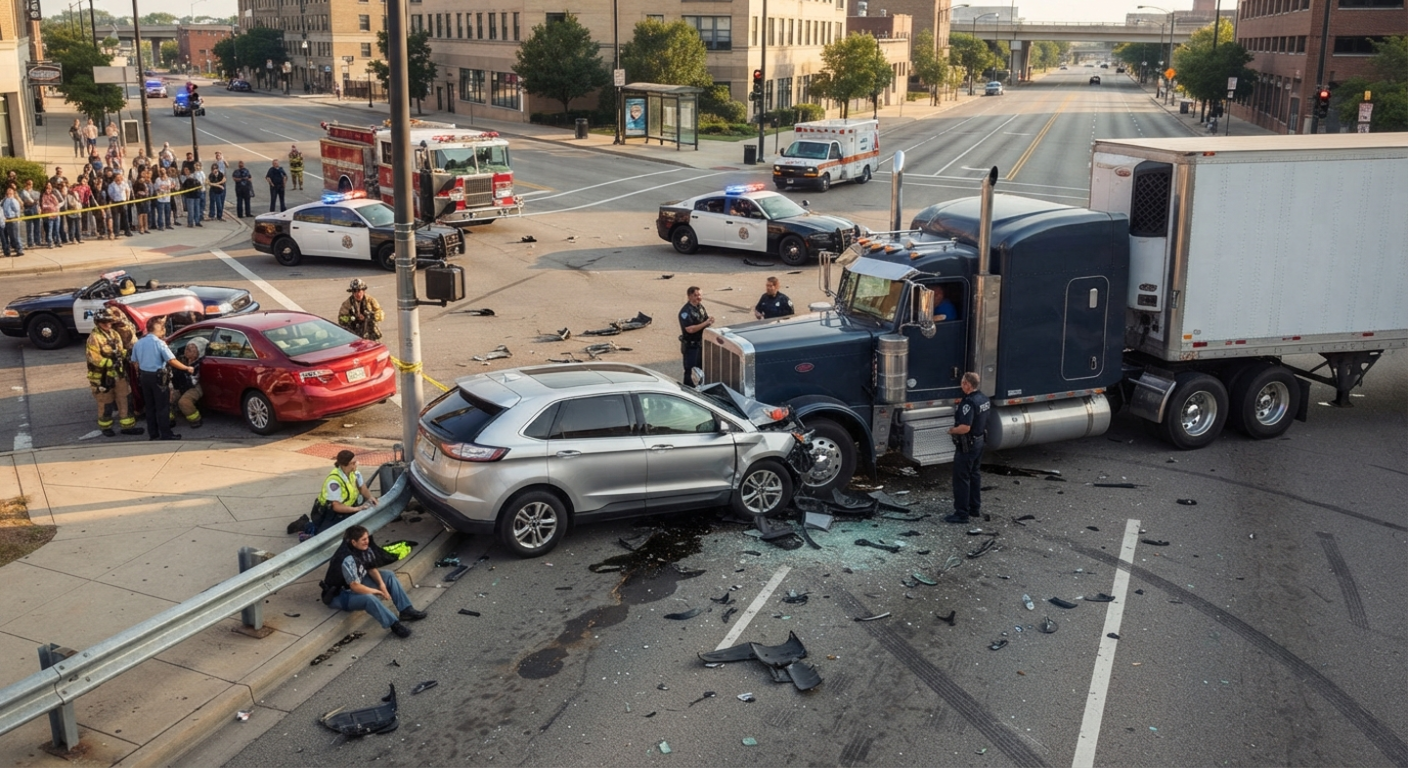
A Texas commercial truck accident claim is different from an ordinary car accident claim because the investigation can involve more than the two drivers and their vehicles. A commercial trucking operation may involve a motor carrier, driver, vehicle owner, lessor, shipper, loader, maintenance provider, broker, and other companies. It also generates regulated records involving the driver, vehicle, trip, cargo, dispatch, maintenance, and safety systems.
That does not mean every truck accident automatically creates liability for the trucking company or that every commercial claim is worth more than a car accident claim. The important difference is the scope of the investigation.
In a serious truck case, counsel may need to determine who controlled the relevant safety decision, what records were created, what those records actually establish, whether the records are complete, and whether the alleged safety problem was a substantial factor in causing the collision and injuries.
That is why a truck accident vs. car accident claim comparison should focus on the evidence and legal issues behind the accident, not simply the size of the vehicles.
The Main Difference: A Truck Crash Can Require a Systems Investigation
A passenger-vehicle collision can involve extensive evidence too. Modern cars may have event data, cameras, GPS information, mobile-phone records, and other electronic systems.
The distinction is that a commercial trucking operation can involve more custodians, more operational systems, more regulatory requirements, and more business relationships.
A truck may be owned by one company, operated under another company's authority, leased from another business, maintained by a third party, loaded by a shipper, and dispatched through a transportation-management system.
The company's name on the truck does not necessarily answer every liability question.
A useful investigation therefore asks:
- Who owned and operated the truck?
- Who employed or controlled the driver?
- Who controlled dispatch and scheduling?
- Who maintained the tractor and trailer?
- Who loaded or secured the cargo?
- Which company held the relevant records?
- What safety rule or duty is alleged to have been violated?
- What evidence supports that allegation?
- What evidence connects the alleged failure to the collision?
- What evidence connects the collision to the claimed injuries?
The Texas Truck Accident Litigation Knowledge Hub provides a broader framework for these evidence, liability, discovery, and trial issues.
Evidence Must Establish More Than a Safety Violation
One of the most important distinctions in commercial truck litigation is the difference between proving that something went wrong and proving that it caused the accident.
For example, an hours-of-service violation may show that a driver exceeded a regulatory limit. It does not, standing alone, establish that fatigue caused the collision.
Similarly, a maintenance record showing an earlier complaint does not necessarily prove that the complained-of component failed during the accident.
The evidence needs to be connected to the actual collision mechanism.
| Disputed issue | Evidence to investigate | What it can help establish | Important limitation |
|---|---|---|---|
| Driver fatigue | ELD records, dispatch records, supporting documents, work history | Hours worked, duty status, scheduling, possible fatigue timeline | A log violation alone does not prove fatigue caused the crash |
| Braking or speed | ECM/event data, video, physical evidence, reconstruction | Vehicle operation and timing immediately before impact | Recorded values require technical interpretation |
| Mechanical failure | Inspection, maintenance, repair records, component examination | Condition of the vehicle and prior complaints or repairs | Crash damage must be distinguished from a preexisting defect |
| Company responsibility | Employment, leases, contracts, dispatch and control records | Which entity controlled the relevant operation | A company's involvement in transportation alone does not establish liability |
| Cargo problem | Bills of lading, loading records, photographs, weight records | Who handled the cargo and how it was prepared | A shipping document alone does not prove negligent loading |
| Unsafe lane change | Camera footage, damage patterns, witness testimony, vehicle data | Vehicle positions and movements | Damage must be interpreted with the scene and other evidence |
This approach is more useful than simply listing records because it asks what each item actually proves.
Electronic Evidence Is Not One Category
Truck electronic evidence should not be treated as a single “black box.”
Different systems record different information.
ELD Records
An electronic logging device primarily concerns driver duty status and hours-of-service information. Federal regulations governing hours of service and ELDs are contained in 49 C.F.R. Part 395.
ELD information can help establish when a driver was working, driving, resting, or making status changes.
But an ELD does not automatically establish fatigue. Counsel may need to compare the log with dispatch records, GPS information, fuel stops, delivery schedules, communications, and other evidence.
ECM and Event Data
Engine-control or event-related data can contain information about vehicle operation, depending on the truck, manufacturer, configuration, and recording system.
Potential information may include speed, braking, throttle position, engine conditions, diagnostic events, or other recorded parameters.
The available data and its meaning must be determined from the particular system. A screenshot or summary should not automatically be treated as equivalent to the native data.
Telematics
Telematics platforms can provide information such as location, vehicle alerts, communications, trip activity, or other operational information.
The important question is what system generated the record, who maintains it, what fields are actually recorded, and whether the timestamps can be reconciled with other evidence.
Camera Systems
Forward-facing and driver-facing cameras may provide visual evidence of the moments before a collision.
The original file can be more useful than a screenshot because timestamps, metadata, surrounding footage, and other technical information may matter when determining what the recording shows.
These systems can also disagree.
An ELD time, GPS timestamp, camera timestamp, dispatch message, and event-data record may not use the same clock or time zone. A careful investigation therefore builds a timeline and compares independent sources rather than selecting the record that appears most favorable.
Driver and Company Records Can Support Different Liability Theories
Commercial motor carriers are subject to federal requirements concerning driver qualifications and carrier responsibilities. 49 C.F.R. Part 391 addresses driver qualifications and related motor-carrier duties.
Depending on the facts, relevant records can include:
- Driver qualification files
- Training records
- Medical qualification records
- Employment applications
- Safety evaluations
- Hours-of-service records
- Dispatch communications
- Driver inspection reports
- Maintenance records
- Company safety policies
These records can serve different purposes.
A qualification file may help determine whether the driver met applicable requirements. Training records may show what instruction was provided. Dispatch records may help establish scheduling and operational decisions. Prior complaints may become relevant only after determining what they concerned, who received them, what action followed, and whether the subject was connected to the later crash.
The point is to connect the record to a specific legal or factual issue rather than treating every company document as proof of negligence.
Truck and Trailer Maintenance Evidence
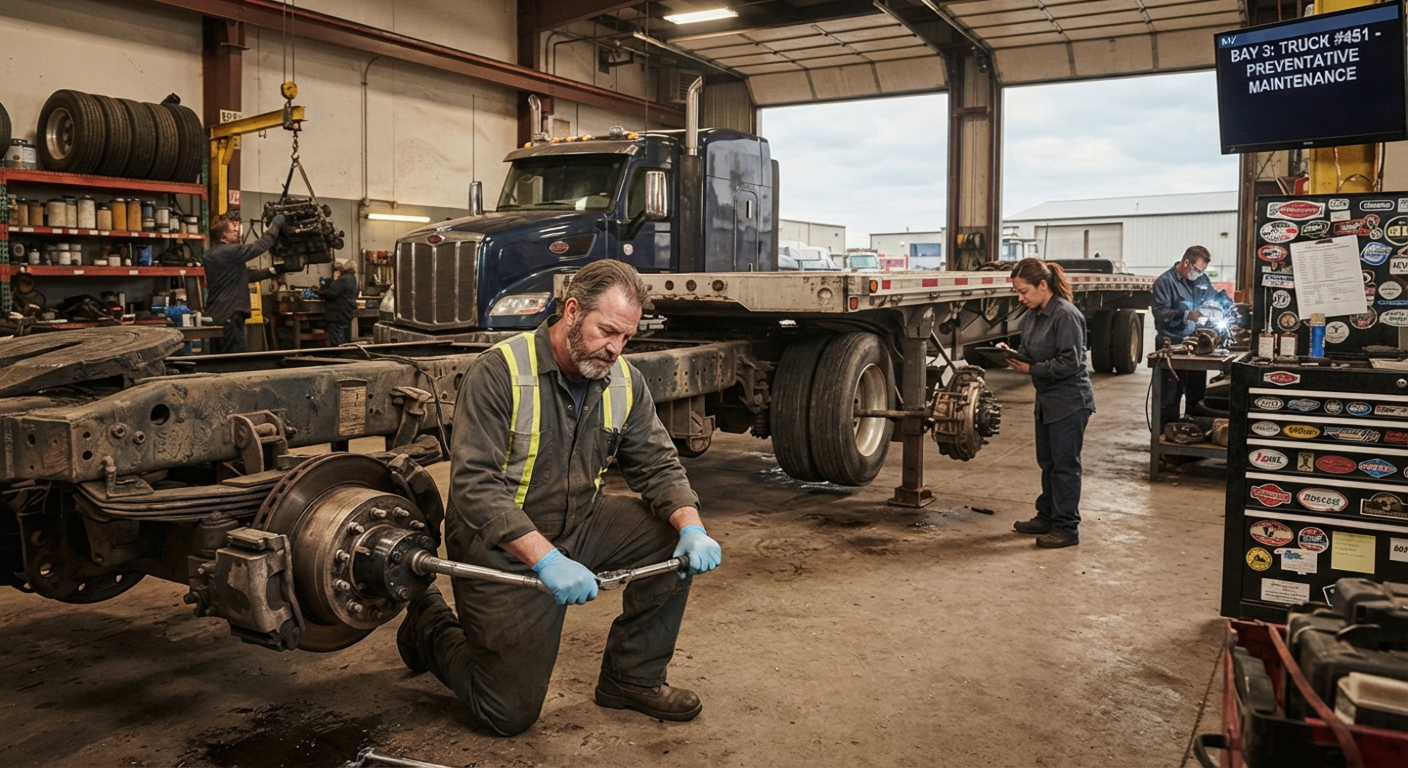
A commercial vehicle can generate a maintenance history that is much more extensive than the information normally available in a passenger-car accident.
Federal regulations address inspection, repair, and maintenance in 49 C.F.R. Part 396.
Potential evidence includes:
- Driver vehicle inspection reports
- Repair orders
- Work orders
- Maintenance schedules
- Brake records
- Tire records
- Inspection records
- Component replacement records
- Recall information
- Trailer inspection records
The physical tractor and trailer may be equally important.
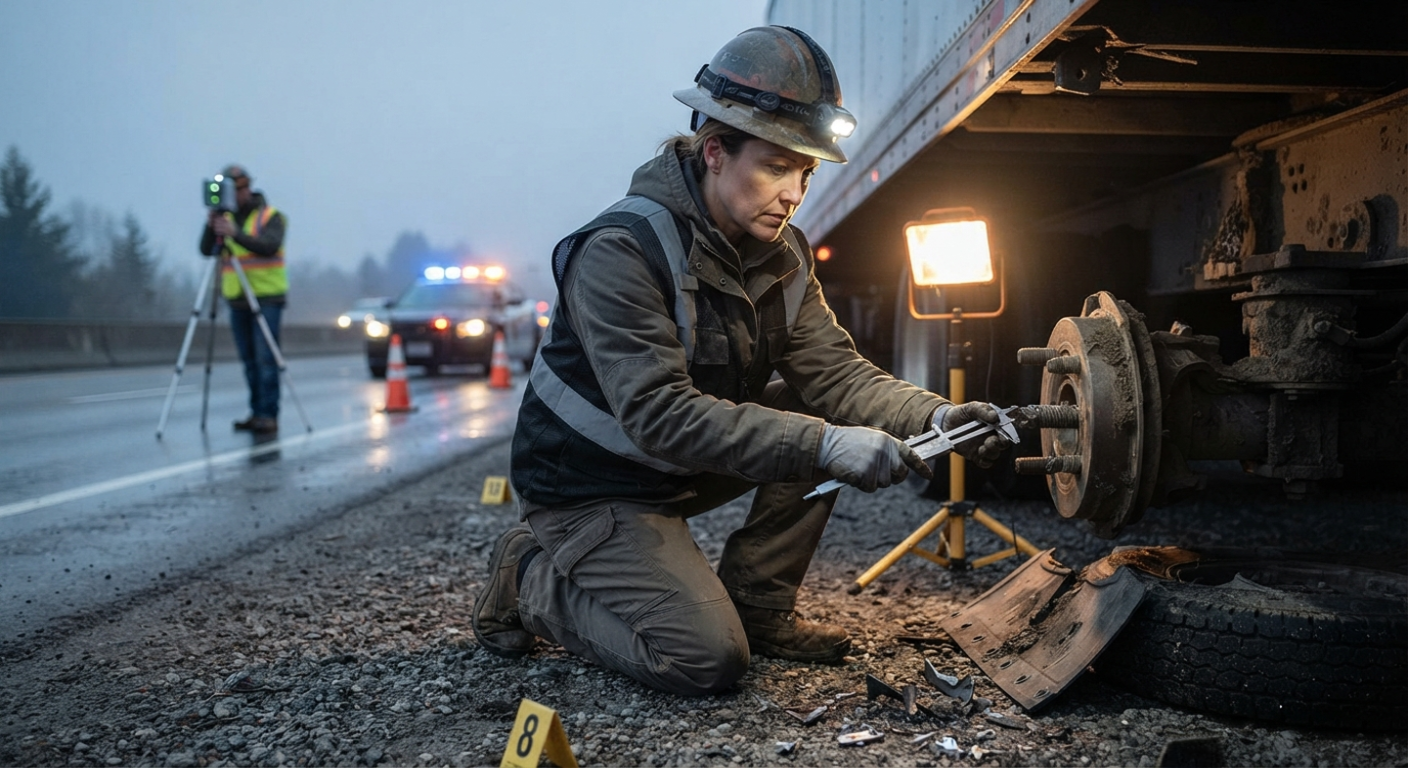
If a brake, tire, steering component, coupling device, or other part is alleged to have caused the crash, the component should be examined before repairs or replacement change its condition.
The fact that a component was damaged in the collision does not necessarily prove that it was defective before impact. That distinction often requires physical inspection and, where appropriate, expert analysis.
Cargo and Loading Records Can Identify Another Part of the Transportation Chain
Cargo-related crashes can raise questions about the shipper, loader, warehouse, carrier, and driver.
Relevant evidence may include bills of lading, weight tickets, loading instructions, cargo photographs, securement records, and communications concerning the load.
But a company's name on a bill of lading does not by itself establish negligence.
The investigation should determine who actually loaded the cargo, who had responsibility for securement, whether the equipment was appropriate, what inspections occurred, and how the condition of the cargo contributed to the collision.
This is particularly important in cases involving shifting or falling cargo and injuries from 18-wheeler accidents.
Why Proving Negligence Is Not the Same as Proving Causation
The Texas Supreme Court's decision in Werner Enterprises, Inc. v. Blake is an important reminder that an alleged safety failure still has to be connected to the injury.
In Werner, the Court reversed and rendered judgment for the defendants on causation grounds in the particular cross-median collision. The Court concluded that the evidence did not establish that the Werner driver's conduct was a substantial factor in causing the plaintiffs' injuries. The Court also did not decide the proposed “Admission Rule.”
The practical lesson is straightforward.
Suppose a truck driver was traveling faster than the plaintiff believes was reasonable. That fact alone does not answer whether the speed caused the collision.
The investigation should ask:
- What was the truck's speed?
- What were the roadway and weather conditions?
- What happened immediately before impact?
- How much time did the driver have to react?
- Would the collision have occurred at a different speed?
- What does the physical evidence show?
- What do independent records show?
- What does accident reconstruction establish?
The same reasoning applies to training, supervision, maintenance, fatigue, cargo, and other alleged safety failures.
A record becomes persuasive when it is connected to the actual mechanism of the crash.
Texas HB 19 and Chapter 72 Can Affect Commercial Truck Litigation
Texas commercial motor vehicle litigation also has procedural features that distinguish it from an ordinary car accident case.
Texas Civil Practice and Remedies Code Chapter 72 contains specific provisions governing qualifying civil actions involving commercial motor vehicles. Section 72.052 provides for bifurcated trials when a defendant makes a timely motion. The first phase addresses liability for and the amount of compensatory damages, while the second phase addresses exemplary damages. Other provisions address employer stipulations and the presentation of certain claims and evidence.
This matters because the way evidence is developed and presented can depend on the claims being pursued and the applicable statutory framework.
For practitioners, Chapter 72 should be considered when developing discovery and trial strategy rather than added as an afterthought.
For an injured person, the practical takeaway is simpler: a commercial truck case can involve procedural issues that do not arise in the same way in an ordinary passenger-vehicle claim.
The firm's Texas Truck Accident Litigation Guide provides a more detailed discussion of evidence, HB 19, responsibility, discovery, and trial preparation.
Commercial Truck Insurance Requires a Separate Investigation
Insurance is another area where commercial truck cases can differ from ordinary car accidents.
FMCSA's current requirements vary according to the carrier, vehicle, cargo, and type of operation. For example, FMCSA lists $750,000 in minimum public-liability coverage for certain for-hire property carriers operating vehicles with a GVWR of at least 10,001 pounds and transporting nonhazardous property in interstate or foreign commerce. Other categories have different requirements.
The existence of a commercial policy does not automatically determine the value of a claim.
The investigation may need to identify:
- The motor carrier
- The vehicle owner
- The lessor
- The applicable liability policies
- Additional or excess coverage
- Other potentially responsible companies
- The type of transportation involved
The coverage analysis should follow the actual parties and operation rather than assuming that every truck has the same insurance structure.
Preservation Is Different From Obtaining Evidence
Another important distinction is between preserving evidence and obtaining evidence.
A preservation request asks a person or company to retain information that may be relevant to a dispute. It does not automatically give the injured person possession of the truck, access to every company database, or the right to take another party's equipment.
For example, an injured claimant cannot simply take possession of the tractor because it may contain evidence.
Instead, counsel may need to identify the owner and custodian, send appropriate preservation requests, arrange an inspection, seek discovery, or ask the court for appropriate relief when necessary.
Both the tractor and trailer may need examination. Repairs, unloading cargo, replacing components, moving the equipment, or returning it to service can change the condition of the evidence.
The same concern applies to third-party custodians.
A camera recording may belong to a nearby business. GPS or telematics data may be maintained by an outside vendor. Dispatch information may exist in a separate transportation-management system.
A preservation plan therefore should identify who has the evidence, not simply what evidence exists.
Why Dallas-Fort Worth Investigation Can Require Local Follow-Up
Listing Dallas highways alone does not make a truck article locally useful.
A meaningful DFW investigation asks what evidence may exist around the actual collision location.
For a crash on I-20, I-30, I-35E, I-35W, I-45, US-75, Loop 12, or another major corridor, investigators may examine nearby businesses, roadway work areas, private surveillance systems, witnesses, traffic-management sources, and available agency records.
Not every camera records continuously, and not every requested recording will exist. The investigation should therefore identify potential custodians quickly and determine whether a particular system actually captured the relevant period.
Roadway evidence also needs to be separated from driver conduct. A construction-zone configuration, lane closure, visibility issue, signal timing, or roadway defect may be relevant, but the existence of a roadway condition does not by itself establish that it caused the crash.
A Dallas truck accident lawyer can evaluate the driver, carrier, vehicle, roadway, and available evidence together.
If roadway conditions are disputed, a Texas Highway Accident Lawyer may need to examine the roadway evidence separately.
If the collision involves an unsafe lane change or side-impact event, a Texas Sideswipe Accident Lawyer can evaluate the vehicle positions, damage patterns, video, and witness evidence.
How Multiple Parties Affect a Texas Truck Claim
Texas Civil Practice and Remedies Code Chapter 33 provides a framework for determining percentages of responsibility among qualifying claimants, defendants, settling persons, and designated responsible third parties. A claimant whose percentage of responsibility is greater than 50 percent may not recover damages under Section 33.001.
That makes complete investigation important.
If evidence suggests that the driver, carrier, maintenance provider, shipper, or another party contributed to the accident, counsel must determine what evidence supports each theory.
The goal is not to name every company associated with the shipment.
The goal is to identify the parties for whom there is evidence supporting a legally recognized theory of responsibility and a causal connection to the injury.
What Makes a Truck Accident Claim More Demanding?
The difference between a commercial truck accident claim and an ordinary car accident claim can be summarized in five questions:
Who has the evidence?
A trucking company, driver, shipper, maintenance provider, vendor, or third party may control different records.
What does the evidence actually prove?
A log, inspection record, photograph, or complaint may establish one fact without proving causation.
Are the records consistent?
ELD, ECM, telematics, camera, dispatch, GPS, and physical evidence may need to be reconciled.
Which legal rules apply?
Federal motor-carrier regulations and Texas statutes can affect the investigation and litigation.
Can the evidence connect the alleged failure to the injury?
That final connection is essential. A safety violation, company policy violation, or prior complaint does not automatically prove that the conduct caused the crash.
What Should an Injured Person Do After a Commercial Truck Crash?
After a serious truck collision, obtain appropriate medical care and preserve photographs, witness information, vehicle information, medical records, and other evidence available to you.
Do not assume that the police report contains everything needed to investigate the case.
If the crash caused serious injury or death, early legal review can help identify the companies and systems that may possess important evidence. It can also help determine whether the tractor, trailer, cargo, electronic records, or other physical evidence should be preserved and inspected.
For a serious commercial truck accident claim in Texas, the earlier the investigation identifies potential evidence custodians, the less likely it is that important information will be lost through ordinary business operations.
Conclusion
Commercial truck accident claims are different from ordinary car accident claims because the investigation often extends beyond the driver and the crash scene.
The relevant evidence may include ELD records, ECM or event data, telematics, camera footage, driver qualification files, maintenance records, cargo documents, dispatch communications, contracts, insurance information, and physical evidence from the tractor and trailer.
But collecting records is only the beginning.
A strong investigation asks what each record establishes, what it does not establish, whether another source confirms it, and how the evidence connects the alleged safety failure to the collision and injuries.
That approach serves both injured clients and attorneys evaluating a serious Texas truck case.
If you need an 18-wheeler truck accident lawyer in Dallas, The Law Firm of Aaron A. Herbert, P.C. can review the available evidence, identify questions that may require further investigation, and discuss the next steps in your case.
Frequently Asked Questions
1. How is a commercial truck accident claim different from a car accident claim?
A commercial truck claim can involve more parties, regulated records, electronic vehicle systems, commercial insurance, cargo documents, maintenance records, and federal safety requirements. The investigation may therefore be broader than a typical passenger-vehicle collision.
2. Does a trucking violation automatically prove negligence?
No. The investigator must first determine whether the regulation applied, whether it was violated, who was subject to the requirement, and whether the alleged violation is connected to the collision and claimed injury.
3. What electronic evidence should be preserved after a truck accident?
Depending on the vehicle and systems involved, relevant evidence may include ELD records, ECM or event data, telematics, GPS information, camera footage, dispatch messages, and mobile-device information.
4. Can a trucking company be liable for its driver's conduct?
Potentially, depending on the driver's relationship with the company, the scope of the driver's work, the claims asserted, and applicable Texas law. Separate theories involving hiring, training, supervision, or maintenance may require their own factual and legal analysis.
5. Does commercial truck insurance mean the claim is worth more?
No. Commercial insurance requirements vary by the type of carrier and operation, and the value of an injury claim depends on liability, causation, injuries, damages, applicable coverage, and other facts.
6. What is HB 19 in a Texas truck accident case?
HB 19 added provisions to Texas Civil Practice and Remedies Code Chapter 72 governing qualifying commercial motor vehicle actions, including rules concerning bifurcated trials and certain employer-related claims and evidence.
7. Why is early evidence preservation important?
Truck evidence can change quickly. Vehicles may be repaired, cargo unloaded, components replaced, video overwritten, and electronic records moved between systems or custodians. Early preservation can help identify and protect evidence before those changes occur.
Legal Sources
- Texas Civil Practice and Remedies Code Chapter 72 — Commercial Motor Vehicle Actions
- Texas Civil Practice and Remedies Code Chapter 33 — Proportionate Responsibility
- 49 C.F.R. Part 391 — Driver Qualifications
- 49 C.F.R. Part 395 — Hours of Service and Electronic Logging Devices
- 49 C.F.R. Part 396 — Inspection, Repair, and Maintenance
- 49 C.F.R. Part 387 — Financial Responsibility
- Werner Enterprises, Inc. v. Blake, Supreme Court of Texas, 2025
- Federal Motor Carrier Safety Administration — Insurance Filing Requirements
About Aaron A. Herbert
The Law Firm of Aaron A. Herbert, P.C. represents people injured in serious motor vehicle and commercial truck accidents.
Aaron A. Herbert has practiced law in Texas since 2002 and has been Board Certified in Personal Injury Trial Law by the Texas Board of Legal Specialization since 2008. He is a Dallas native and former U.S. Marine whose practice focuses on personal injury litigation, including truck accidents, 18-wheeler collisions, catastrophic injuries, and wrongful-death claims.
For a serious truck collision, the investigation may require more than determining who was driving. It can require tracing the vehicle, driver, carrier, cargo, maintenance, electronic systems, insurance, and other business relationships involved in the trip.
If you need an 18-wheeler truck accident lawyer in Dallas, contact The Law Firm of Aaron A. Herbert, P.C. for a free consultation. There are no fees or expenses unless you recover.