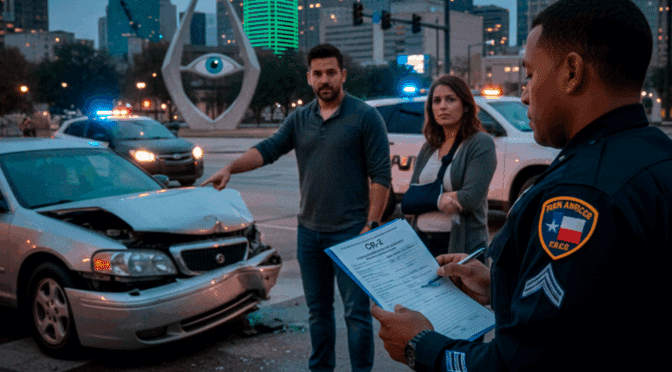
What Is a Blue Form Accident Report
Car accidents in Dallas can feel overwhelming, especially when you’re unsure which documents or reports to complete after the crash. Many drivers still hear the term “Texas blue form” and wonder whether it applies to their situation. The confusion often leads to delays in filing insurance claims or weakens evidence that could protect a driver’s rights. The Law Firm Of Aaron A. Herbert, P.C. helps injured drivers across North Texas understand what documentation matters most after an accident, ensuring no critical detail gets overlooked.
The Blue Form is Texas’ Driver’s Crash Report. After a
car accident that causes personal injuries, deaths or more than $1,000 in property damages, the driver of a vehicle involved in the accident will need to call the police from the scene of the crash. However, the Blue Form is something the driver of the vehicle must complete and sign after any accident. Someone else may only complete the form for the driver with a valid reason, given in writing. The form has several parts.
- Location of the accident
- Date of the accident
- Vehicles involved
- Damage to property
- Injuries
- Driver’s statement of what happened
- Signature
The driver should fill out the Blue Form as completely as possible. The driver’s statement does not require the driver to admit fault or to speculate about who caused the accident. It simply asks for the driver’s side of the story. Once completed and signed, the driver can print the report and mail it to the Texas DOT’s Crash Records Department. For assistance filling out a Blue Form, a driver can call (844) 274-7457.
Contact Us Now
Texas blue forms are no longer required or accepted by TxDOT. TxDOT stopped collecting these forms on September 1, 2017, transferring responsibility for crash reporting entirely to law enforcement agencies. Before 2017, drivers completed the CR-2 when a crash resulted in at least $1,000 in property damage, injury, or death, and law enforcement did not conduct an investigation. This requirement appeared in the official
Texas CR-2 Blue Form document.
Since the change, law enforcement officers, not drivers, file the official crash report, known as the CR-3. This report becomes part of the permanent record maintained by TxDOT. Any driver involved in a wreck should request a certified copy through the TxDOT Crash Records Information System (CRIS) or from the Dallas Police Department Records Unit if the crash occurred within city limits.
For collisions not investigated by law enforcement, motorists should still gather all necessary information to record the incident. Although the
Texas blue form no longer carries legal weight, preserving accurate documentation and photographic evidence after a wreck can help protect an injury claim if disputes arise later:
- Record the date, time, and location of the collision.
- Photograph vehicle damage, roadway conditions, and visible injuries.
- Collect names, license plate numbers, and insurance details.
- Obtain a copy of the police report if an officer investigates the scene.
These steps provide a solid foundation for proving fault and protecting your rights after a Dallas car accident.
To Whom Should I Call If I’m Involved in a Car Accident?
Texas Transportation Code §550.062 requires a law enforcement officer who investigates a motor vehicle collision in the regular course of duty to make a written report if the collision resulted in injury to or death of a person, or damage to the property of any one person to the apparent extent of $1,000 or more. This details the circumstances, contributing factors, and parties involved.
If anyone appears injured, call 911 right away. A Dallas Police Department officer or Texas Highway Patrol trooper will secure the scene, gather statements, and create the official CR-3 accident report. This document often determines liability and influences insurance settlements.
When law enforcement cannot arrive, often during severe weather or periods of high call volume, drivers should still report the crash afterward. In Dallas, drivers may:
- Visit the Dallas Police Department Records Section.
- Call the Records Unit to confirm the availability of the report.
- Access the TxDOT CRIS portal to order certified or uncertified copies for $6 or $8.
Reports typically become available within five to ten business days, depending on agency processing. After ensuring safety, exchange insurance details, photograph the scene, and avoid admitting fault. Contacting a
Dallas personal injury lawyer early in the process helps protect evidence, facilitates negotiations with insurers, and pursues fair compensation for medical expenses, lost income, and vehicle repairs.
In most cases, the police will submit a different form, the CR-3, on behalf of crash victims. If the police fill out a CR-3, you will not need to use a Blue Form after an accident. The Blue Form is only necessary if for some reason you do not call the police or the police decide not to write up a police report. The police may tell you from the scene to fill out a CR-2 rather than giving you a police report for various reasons. You should use a Blue Form to report a car accident to the DOT even if it did not cause significant property damage, injuries or deaths.
The purpose of a Blue Form is to document your car accident for the DOT for statistical reasons. It allows involved drivers to record the details of the accident while they are still fresh in their minds. The DOT wants to know anytime a crash occurs, even if the police do not need to file a CR-3. Submitting the Blue Form to the DOT in lieu of a police report can help the department track the number and locations of accidents in the state.
Can I Hire a Car Accident Lawyer for My Case?
It is a common misconception that a Blue Form crash report in Texas will help an insurance claim. Although it can be useful to document an accident, its main purpose is to help the DOT keep track of collisions. The CR-2 has no authority. It is not an official police report of your accident. An insurance company does not have to believe what is on the Blue Form or use it to validate your claim. Instead, an insurer will generally conduct its own investigation to determine fault for an auto accident.
If you get into a car accident that injures you, contact a
Dallas car crash attorney to take care of processes such as documenting your damages and negotiating with an insurance provider for you. Hiring a car crash lawyer can strengthen your injury case. Your car crash lawyer will know how to build your case for its best odds of successfully achieving a settlement. If an insurance company refuses to treat your claim fairly, your lawyer can take your case to trial in
Texas. Hiring a lawyer can allow you to focus on healing while a legal professional handles your claim.
Car accidents in Dallas often occur on major routes such as I-35E, Central Expressway, and the Dallas North Tollway. Victims frequently face painful injuries and expensive medical bills. An experienced attorney understands how Texas crash reporting rules affect the success of a personal injury claim and can manage the entire process.
At
The Law Firm Of Aaron A. Herbert, P.C., our
board-certified personal injury trial attorney assists drivers throughout Dallas who are recovering from serious collisions, including those previously documented with the outdated
Texas blue form. Our legal team examines police reports, retrieves missing documentation, and identifies negligent parties responsible for damages.
Call
214-200-4878 or fill out
our online contact form to schedule a
free consultation today and speak with an experienced Dallas car accident attorney who stands ready to defend your rights, manage communications with insurers, and pursue the justice you deserve.