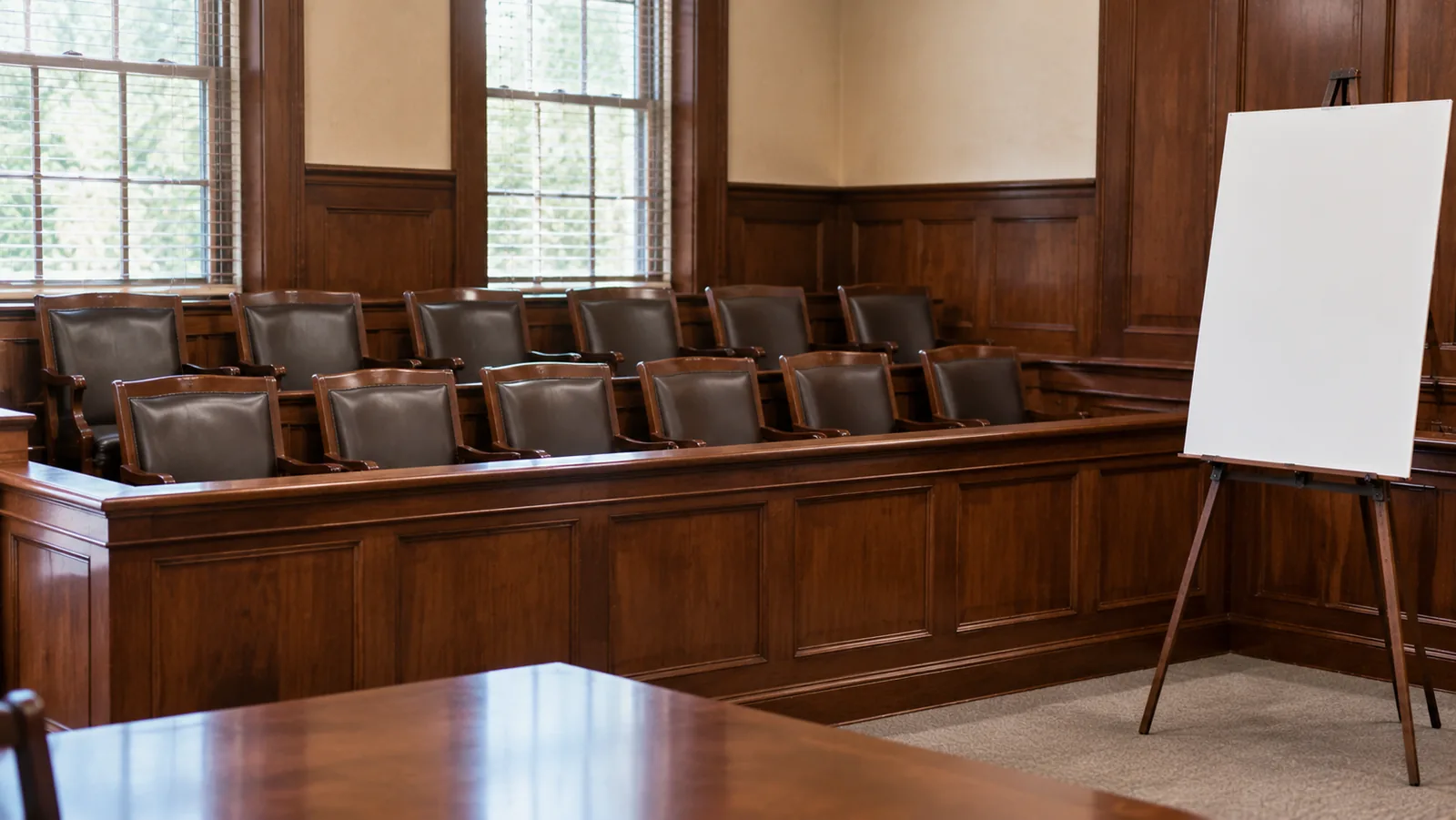
La respuesta corta
A grocery fall trial is built around the few questions the jury will actually answer, like whether the store knew about the puddle in time to clean it up. Preparing for trial can sharpen your settlement decision, but it doesn't guarantee Tom Thumb or Albertsons will settle or pay any amount.
| Fase | ¿Qué puedes esperar? |
|---|---|
| Selección del jurado | Your lawyer looks for bias within limits the judge sets, and jurors can't be asked to promise a verdict. |
| Mediación | The decision is yours, based on an honest look at the evidence, the costs and what you'd keep. |
| El cuadro más grande | El Centro de información sobre lesiones de Tom Thumb y Albertsons lists related guides, and the guía de litigios covers each stage of the case. |
What will the jury actually decide?
Usually one or two disputed facts, not whether grocery chains are careless.
Possible disputed facts
- Whether the 2:05 p.m. report about water "by the milk" meant the spot where you fell at 2:14 (a hypothetical).
- Whether the mat curl was visible from three steps back.
- Whether your knee surgery came from the fall or an old injury.
What has to be proved for each, in the same order.
- That the report, the radio call and the fall involved the same place.
- What a shopper could see while walking toward it.
- Medical testimony that separates the new injury from the earlier one.
A good theme is narrow enough to prove. Your lawyer works backward from the expected jury questions and checks which witness or exhibit supports each piece, and a missing link is better found in July than mid-trial.
Themes, and why each works or doesn't
- "The manager got the radio call and the aisle stayed open," which depends on evidence about the call, the time and the spot.
- "Stores have to prevent every fall," which overstates the law.
- A careful notice case that never explains why you stopped coaching your kid's soccer team, which leaves the damages question thin.
- A moving medical story with no proof of notice, which can't fill the gap in the notice proof.
¿Para qué sirve la selección del jurado?
Voir dire is the questioning of the jury panel to find people whose beliefs would keep them from deciding fairly, on either side.
Lo que dicen las reglas
- A challenge for cause rests on a fact that disqualifies a juror by law or, in the court's opinion, makes the juror unfit (Texas Rule of Civil Procedure 228). S6
- Each party generally gets six peremptory challenges in district court and three in county court, though multi-party cases can change the count (Rule 233).
| Regla o caso | Que dice |
|---|---|
| Hyundai Motor Co. contra Vasquez, 189 SW3d 743 (Tex. 2006) | The plaintiffs' lawyer wanted to ask whether jurors would be predisposed against them because a child wasn't wearing a seat belt. The Texas Supreme Court said it's improper to ask jurors what their verdict would be if certain facts were proved, and that substance, not wording, decides whether a question crosses that line. The trial court didn't abuse its discretion by refusing the question. N1 |
These prompts are teaching examples, not approved questions, and the judge may limit any of them. Follow-up matters more than the first question.
Prompts your lawyer might adapt
- Who here feels a shopper who falls is always to blame for not looking down?
- Has anything happened to you or your family that would affect how you view a grocery chain in a lawsuit?
- How would you feel about evidence that a fall made an existing back problem worse?
- What comes to mind when you hear someone sued after a fall at a store?
The topic of each, in the same order.
- Looking where you walk.
- Big companies as defendants.
- Old injuries.
- Injury lawsuits generally.
Your lawyer should record each answer as given, not stretch it. Protected characteristics never stand in for what a juror actually says.
What a panel member says, and what may follow
- "I'm skeptical of injury suits," which may still leave the person able to follow the instructions.
- "No shopper should recover for a fall, whatever the proof," which may get the person struck for cause.
How witnesses are lined up
Each witness covers only what that witness knows.
Lo que cubre cada testigo
- Where they stood and what they saw, for the shopper in the next aisle.
- The sweep log or camera system, for the store's records custodian.
- History, findings, diagnosis, causation and prognosis, for your treating doctor.
- The method and why it fits, for a retained expert.
You'll be prepared to testify truthfully, including about what you don't remember.
Su preparación
- An early estimate that turned out wrong, such as a first account that said "around 3" when the receipt says 2:41, so your lawyer helps you explain the difference honestly.
- Courtroom logistics, such as breaks, accommodations and how exhibits will look on the courtroom screen.
How cross-examination works
Cross-examination tests a specific point, not a personality.
What cross-examination tests with each witness
- An assistant manager who knows the sweep routine but remembers nothing about aisle 9 that afternoon, where your lawyer draws out that difference politely, then asks for the sheet showing the time and the route.
- A video clock and an incident report that disagree, where the clocks get reconciled before anyone claims a contradiction.
- A defense expert relying on a dry-floor test months later or a display layout that changed, where the test is what that method can and can't show.
- Your own witnesses, who get the same scrutiny before trial.
Being paid isn't proof of dishonesty, so the weakness has to be in the reasoning. A lawyer's question isn't evidence.
errores
- Attacking an expert only for being paid, which skips the reasoning, where any real weakness lies.
- Hinting at facts nobody can prove, which can backfire with the jury.
What makes a demonstrative fair?
A fair demonstrative shows what's known, what's estimated and what's unknown.
What each exhibit should show
- The 2:05 report, the 2:07 radio call and the 2:14 fall as recorded times, with gaps labeled as gaps and no 40-minute puddle unless evidence supports it, for a timeline.
- Whether it's to scale and where its measurements came from, for a diagram.
- A printed copy of key exhibits in case the courtroom screen fails, for a backup.
Ownership and control questions need the same care, since a drawing helps jurors follow evidence but proves nothing by itself.
| Caso | Que pasó | Lo que dictaminó el tribunal |
|---|---|---|
| Johnson v. Tom Thumb Stores, Inc., 771 SW2d 582 (Tex. App.—Dallas 1989, writ denied) | A shopper fell on a glass light fixture in a common-area sidewalk, and the lease gave the landlord control there. | El tribunal confirmó el veredicto a favor de Tom Thumb, el inquilino, y revocó y devolvió la demanda contra el propietario. S16 |
| What that means for a diagram | A drawing of that sidewalk would have helped jurors follow the lease evidence. | It couldn't have proved the lease terms by itself. |
How the jury questions get fixed
The charge is the written set of questions and instructions the judge gives the jury, and complaints about it follow strict rules. S6
What the charge rules require
- Objections must be presented before the judge reads the charge to the jury, and objections not presented in time are waived (Rule 272).
- Your lawyer must point out distinctly what's wrong and why (Rule 274).
- The judge reads the charge before closing arguments (Rule 275).
- A missing question, definition or instruction generally needs a written request in substantially correct wording, and the complaint needs a ruling (Rule 278).
A charge objection can't supply evidence the trial never produced. If the judge keeps out evidence about what the store knew, your lawyer makes an offer of proof so the ruling can be reviewed.
| Caso | Que pasó | Lo que dictaminó el tribunal |
|---|---|---|
| Albertsons, LLC contra Mohammadi, 689 SW3d 313 (Tex. 2024) (por curiam) | The claimant worked at a Wells Fargo inside a Houston Randalls and slipped in a puddle next to a cart after an employee put leaking items in it. The charge made the actual-knowledge question depend on the constructive-knowledge answer, a structure the Court called unusual, and the jury answered "No" on constructive knowledge and never reached the other question. | The Supreme Court assumed the charge was wrong, held the error harmless because the record had no evidence of actual knowledge, and reinstated a take-nothing judgment. S15 |
| Brookshire Bros. contra Aldridge | A $1,063,664.99 award followed a "may consider" spoliation instruction and related evidence about overwritten store video. | The Texas Supreme Court set the award aside and ordered a new trial, showing a charge error can undo a win. S5 |
¿Qué ocurre en una mediación?
A neutral mediator helps both sides talk about settlement, but the choice to settle stays yours.
Qué significan para usted las normas de mediación de Texas.
- The mediator facilitates and can't impose a decision, so no one can force you to settle. N2
- What's said in mediation is generally confidential, with exceptions, so offers and statements there usually can't be used as evidence.
- A signed written settlement can be enforced like any other contract, so read every term before you sign.
Your lawyer's brief should face the weak spots the store already knows, like a short time window or an earlier knee problem. Ask also what further litigation would cost and what it might resolve.
Before you sign, ask
- What you would keep.
- Which companies and claims the release covers.
- When payment arrives and who signs the check.
- Which health plan or program claims a share and whether the amount is final.
- What you can say about the case afterward.
- Whether a court has to approve a minor's claim.
An example of each, in the same order.
- A written estimate after the fee under your actual agreement, case expenses and any reimbursement claims.
- Every store entity named in the release.
- The date and payer written into the agreement.
- A lien letter showing the asserted amount.
- Any confidentiality term.
- A court-approval step for a child's settlement.
The headline number isn't the whole deal, and the opening offer doesn't predict the final one.
What each offer stage tells you
- Little about where the final number lands, for the opening offer.
- Only what the net worksheet shows you'd actually keep, for the final proposal.
After a verdict or settlement
There's usually more to do after the verdict is read.
Steps and rules after the verdict
- The judge signs a judgment, and posttrial motions, appeal deadlines, payment and reimbursement may follow.
- If you're found more than 50% responsible, recovery is barred (Section 33.001). S12
- A smaller share of responsibility reduces the recovery (Section 33.012).
- Past medical expenses are limited to amounts actually paid or incurred (Section 41.0105). S8
- The amount read in court isn't necessarily what gets collected, or when, and your lawyer should explain that gap.
Preguntas comunes
Will my case actually go to trial?
Maybe not. Many cases settle, but preparing as if trial will happen is what tells you whether an offer is fair.
Can my lawyer ask jurors if they'd award money for my injury?
No. Asking jurors to commit to a verdict or a dollar figure on a preview of the facts isn't allowed, but your lawyer can ask how a juror views old injuries.
Does the mediator decide what my case is worth?
No. A mediator can suggest a number, but you decide whether to accept it.
If we win at trial, do I get paid right away?
Not always. Posttrial motions, an appeal and reimbursement claims can delay payment or change the amount.
Hablar con un abogado sobre su caída
Bring your incident report number, treatment records and any court papers, and see the guía de vídeo de vigilancia on early footage requests. To talk with the Law Firm of Aaron A. Herbert, P.C., Solicitar una evaluación del caso o llame al (214) 200-4878.
Aaron Herbert is Board Certified in Personal Injury Trial Law by the Texas Board of Legal Specialization, as his State Bar of Texas profile shows. S1
Fuentes
S1 Aaron Alan Herbert, perfil de abogado del Colegio de Abogados del Estado de Texas (Certificado por la Junta de Especialización Legal de Texas en Derecho Procesal de Lesiones Personales). Leer fuente.
S5 Brookshire Bros., Ltd. v. Aldridge, 438 SW3d 9 (Tex. 2014). Lea la fuente.
Artículo 6 de las Reglas de Procedimiento Civil de Texas. Lea la fuente.
S8 Tex. Civ. Prac. & Rem. Code § 41.0105 (gastos médicos efectivamente pagados o incurridos). Lea la fuente.
S12 Código de Procedimiento Civil y Remedios de Texas §§ 33.001, 33.003, 33.012 (responsabilidad proporcional). Lea la fuente.
S15 Albertsons, LLC contra Mohammadi, 689 SW3d 313 (Tex. 2024) (por curiam). Leer fuente.
S16 Johnson v. Tom Thumb Stores, Inc., 771 SW2d 582 (Tex. App.—Dallas 1989, writ denied). Lea la fuente.
N1 Hyundai Motor Co. v. Vasquez, 189 S.W.3d 743 (Tex. 2006) Lea la fuente.
N2 Tex. Civ. Prac. & Rem. Code ch. 154 (§§ 154.023, 154.053, 154.071, 154.073) Lea la fuente.

SOBRE EL ABOGADO
Aaron A. Herbert
Abogado fundador
Certificado por la Junta en Derecho Procesal por Lesiones Personales
Aaron fundó el bufete de abogados de Aaron A. Herbert en 2010 con el objetivo de desarrollar el caso de cada cliente y obtener la máxima compensación posible. Durante más de una década, ha representado a personas gravemente heridas en accidentes importantes y catástrofes industriales, buscando veredictos favorables en juicios y acuerdos extrajudiciales, al tiempo que se esforzaba por reducir el estrés que conlleva un litigio.
Educación
- Universidad de Texas A&M · Licenciatura en Justicia Penal, 1999
- Facultad de Derecho de la Universidad de Oklahoma · Doctor en Jurisprudencia, 2002; se graduó entre los mejores de su promoción.
Experiencia y enfoque en juicios
Aaron obtuvo numerosos veredictos favorables del jurado en bufetes especializados en litigios por lesiones personales. Según su biografía, durante un año fue el abogado litigante mejor pagado de un bufete que figuraba frecuentemente en las búsquedas de veredictos como uno de los que mayor número de victorias en juicios había conseguido en Texas. En otro bufete de lesiones personales de Dallas, pasó de ser abogado gerente de la fase previa al litigio a abogado gerente de litigios en el transcurso de siete años, mientras el bufete se convertía en uno de los más grandes de Dallas.
Su biografía lo describe como uno de los abogados litigantes más agresivos de Estados Unidos, con importantes indemnizaciones obtenidas por jueces y jurados, así como acuerdos extrajudiciales sustanciales. La mayoría de estos acuerdos incluían cláusulas de confidencialidad solicitadas por la defensa. Aaron ha declarado que las indemnizaciones se justificaban por las lesiones y pérdidas sufridas, que ninguna cantidad de dinero podría evitar.
Su enfoque combina pasión, preparación, perseverancia e imaginación en los tribunales. Cree que un equipo bien respaldado, comprometido y motivado que trabaje en cooperación contribuye a brindar una representación sólida, con el objetivo de lograr el mejor resultado posible para cada cliente.
Orígenes en Dallas, servicio militar y publicación
Nacido y criado en Dallas, Aaron se alistó en el Cuerpo de Marines de los Estados Unidos tras terminar la secundaria y posteriormente recibió una baja honorable. Completó sus estudios universitarios y de derecho después de su servicio militar y, durante su etapa en la facultad de derecho, se convirtió en un fanático de por vida del equipo de fútbol americano Sooners.
Publicación: “Litigios en casos de mordeduras de perro”, Seminario de Derecho Canino de Texas, Dallas, 2009.
Afiliaciones y reconocimientos profesionales
Afiliaciones profesionales y reconocimientos que figuran en la biografía de Aaron:
- Barra del estado de Tejas
- American Bar Association
- Asociación de Abogados Litigantes de América (ahora Asociación Americana para la Justicia)
- Asociación de Abogados Litigantes de Texas
- Asociación de abogados litigantes de Dallas
- Colegio de Abogados de Dallas
- Colegio de Abogados del Condado de Tarrant
- Foro de defensores del millón de dólares
- Los abogados litigantes nacionales: los 100 mejores abogados litigantes